

Why Do Many Good Backtest Strategies Fail in Live Trading?
In the trading community, there's no shortage of strategies shared with impressive backtests: 200% annual returns, low drawdown ratios, high win rates. Many people spend weeks understanding and testing them, only to deploy with real money and discover the actual results are completely different from the backtest.
This is not a rare occurrence. In fact, it's almost a universal law in trading. There are very specific technical reasons that create this gap, and they are systemic limitations rather than something you can avoid simply by "backtesting more carefully."
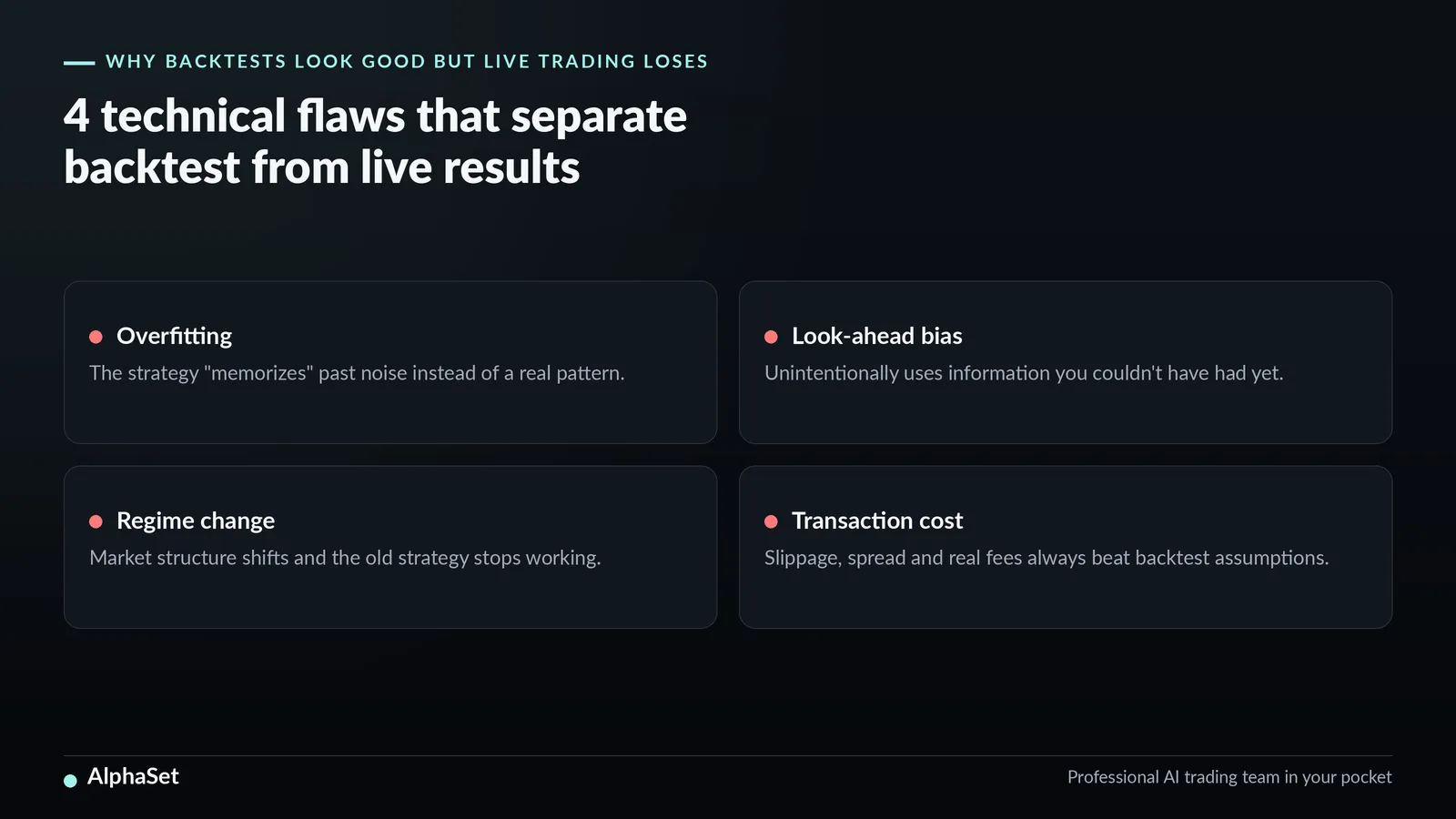
Overfitting: Strategies That Memorize Historical Data
"Overfitting occurs when you deliberately tweak, add, and adjust too many conditions and parameters until the profit curve of your strategy looks absolutely perfect on a historical chart."
Example: You set rules that orders only trigger on Tuesdays, when the RSI indicator is exactly at 31.5, and trading volume must be 12% higher than average. Each time you add such a filter, the backtest results improve slightly.
But the truth is, your strategy hasn't discovered any long-term money-making rule at all. It's simply "memorizing by rote" and forcing itself onto random market noise from the past. When you deploy this "memorizing machine" against completely new future data, it will immediately break and lose money.
Quick detection tip: If adding a parameter significantly improves your backtest results, but you can't explain the economic logic or market behavior behind that parameter, then your strategy is definitely caught in the overfitting trap.
Look-ahead Bias: The "Cheating" Error of Using Future Information
"Look-ahead bias is a serious technical error in code that occurs when a strategy accidentally uses information that shouldn't have been available then in real trading."
Classic example: You program a bot to place a buy order at the exact moment a candle opens, with the condition that the closing price of that same candle must be a green candle. In a computer backtest environment, historical data is already complete, so the bot will calculate with perfect accuracy and produce winning results consistently. But in live trading, how could you possibly know the closing price of a candle when it's just started?
These "data-cheating" errors can be tiny, subtle, and hard to spot among thousands of lines of code, but when accumulated across hundreds of trades, they create a phantom profit in backtest results that has no practical real-world value.
Regime Change: Market Structure Shifts
Even if you own a meticulously built strategy with no code errors and no data overfitting, it can still fail catastrophically when the structure of the crypto market shifts (Regime Change).
In reality, markets constantly change. A strategy that worked well before spot Bitcoin ETFs launched may stop working after ETFs bring institutional flow and change the capital structure. A strategy backtested on 2015-2019 data, when BTC-S&P500 correlation was low, might not work in the post-2020 environment when correlation is high.
This is not a backtest error—it's a fundamental limitation of using past data to predict the future when market structure has already shifted.
Real Transaction Costs Exceed Backtest Assumptions
When backtesting, computers typically assume an ideal environment with minimal costs. But when you deploy real money in the market, various real costs will continuously "gnaw away" at your profits:
-
Slippage: You set a buy order at $60,000, but because the market moves too fast, your order actually fills at $60,050.
-
Spread: The difference between the highest bid and the lowest ask price.
-
Real trading fees (Taker/Maker fee): Exchange fees charged on each order.
For high-frequency trading strategies (placing orders continuously throughout the day), the gap between assumed costs in the computer and real-world costs can easily transform a "super profitable" strategy into breakeven or worse, completely eroding your account.
Alpha Crypto: Multi-Layer Rigorous Verification Before Real Capital Deployment
What is Alpha Crypto?
Alpha Crypto is an automated long/short trading strategy on the top 100 largest coins of AlphaSet, a quantitative investment platform for individual investors. Unlike simply buying and holding, Alpha Crypto scores 100 coins, buys the strongest ones, and shorts the weakest ones, helping you profit in both market directions instead of just waiting for price increases. The long/short ratio adjusts automatically based on market conditions, entirely data-driven and not influenced by emotion. It runs fully automated 24/7 via API on your exchange account. Your capital remains on the exchange—AlphaSet only has permission to place orders, not to withdraw funds.
AlphaSet Verifies Through Multiple Layers Before Live Deployment
Alpha Crypto doesn't stop at backtest.
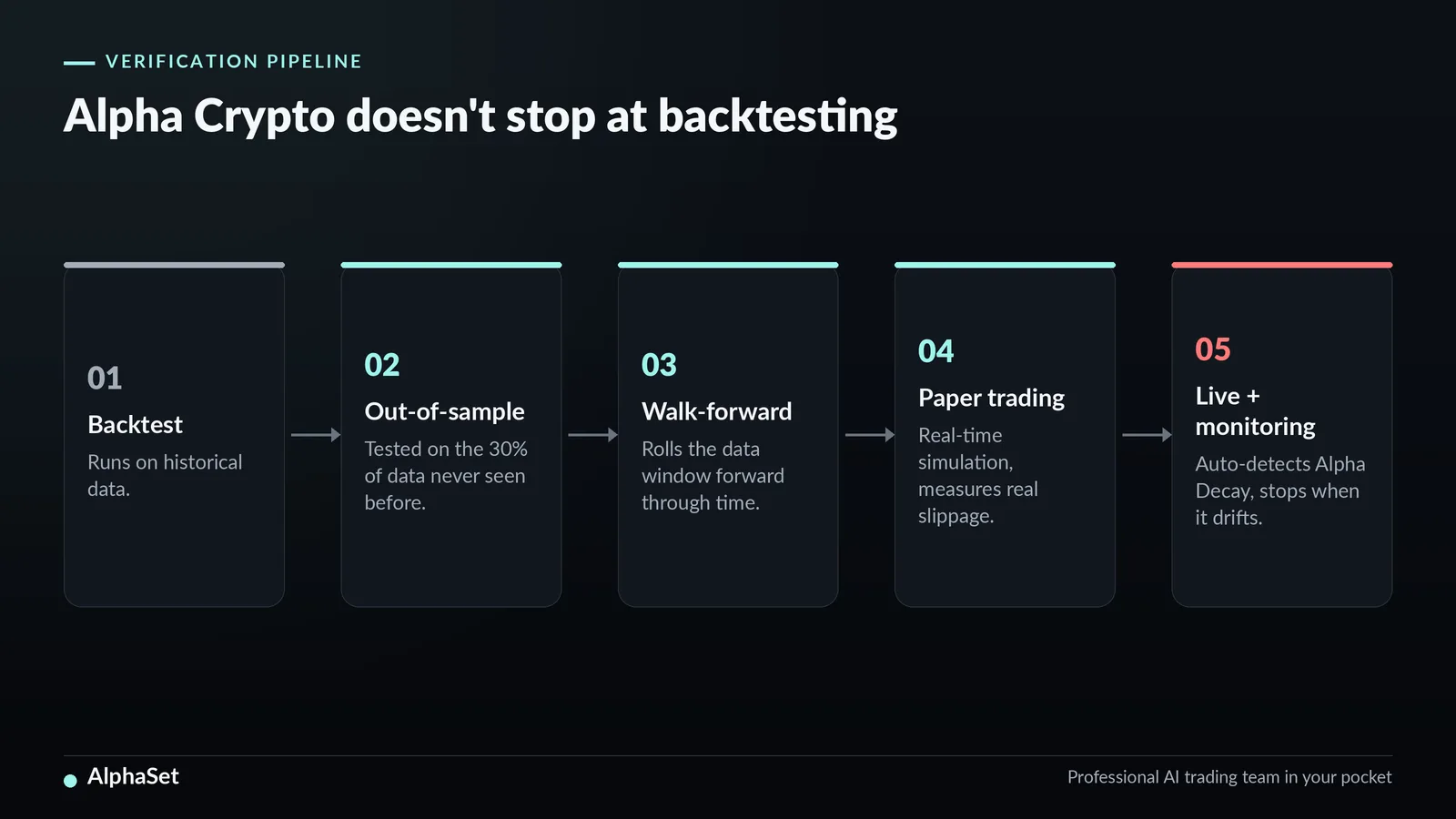
The verification process includes multiple steps:
-
Out-of-sample testing: The system withholds a portion of historical data (e.g., the most recent 30%) and completely prevents the algorithm from accessing it during strategy development. After optimization is complete, the system brings out this 30% of "never-before-seen" data for testing. If results remain strong, the strategy passes the first round.
-
Walk-forward optimization: The algorithm continuously shifts data windows over time to verify whether the strategy maintains stability and survives through different market regime changes.
-
Paper trading & live simulation: The strategy continues running in real-time simulation with live data streams from exchanges to measure hidden costs like slippage and actual spreads accurately.
Automatic Alpha Decay Detection
Every trading strategy in existence has a finite lifespan; one day it will lose its money-making edge as the market evolves—professionals call this Alpha Decay.
The engine's key advantage is that it continuously monitors live results and cross-references them against the model's expected performance chart. The instant it detects actual performance diverging significantly from design expectations, the engine immediately stops the strategy for re-examination, never allowing it to continue stubbornly.
A manual investor typically lacks this measurement system—they often hold onto and endure losses from a strategy past its "expiration date" simply out of nostalgia for past victories.
Trade with confidence on AlphaSet: Your entire capital and assets are secured 100% on your personal exchange account. AlphaSet connects securely via API only to execute automated orders. You simply pay a fixed monthly usage fee, significantly lower than the cost of months deploying overfitted strategies with real money. And all profits are yours—no performance fees.
Ready to get started with AlphaSet?
Activate an Alpha today and let our quants automate your trading.
Get Started