

Win rate vs risk/reward: Which one matters more?
When evaluating a trading strategy, the first question almost everyone asks is: "What is the win rate (Win rate) of this method?" If someone confidently claims they have a win rate of up to 70% on their trades, the natural reaction of most people is admiration and absolute trust. Conversely, if someone honestly shares that they only win 40% of their trades, listeners immediately become skeptical and dismissive.
This flawed way of thinking is precisely why so many investors are continuously attracted to trading groups advertising "undefeated strategies," only to receive bitter and disappointing results in the long term. Win Rate as a standalone metric tells you nothing about the quality or effectiveness of a trading system. The number that truly determines your account's fate is Expectancy Value, and understanding this concept will completely change how you view the art of investing.
Why can a 70% win rate be worse than a 35% win rate?
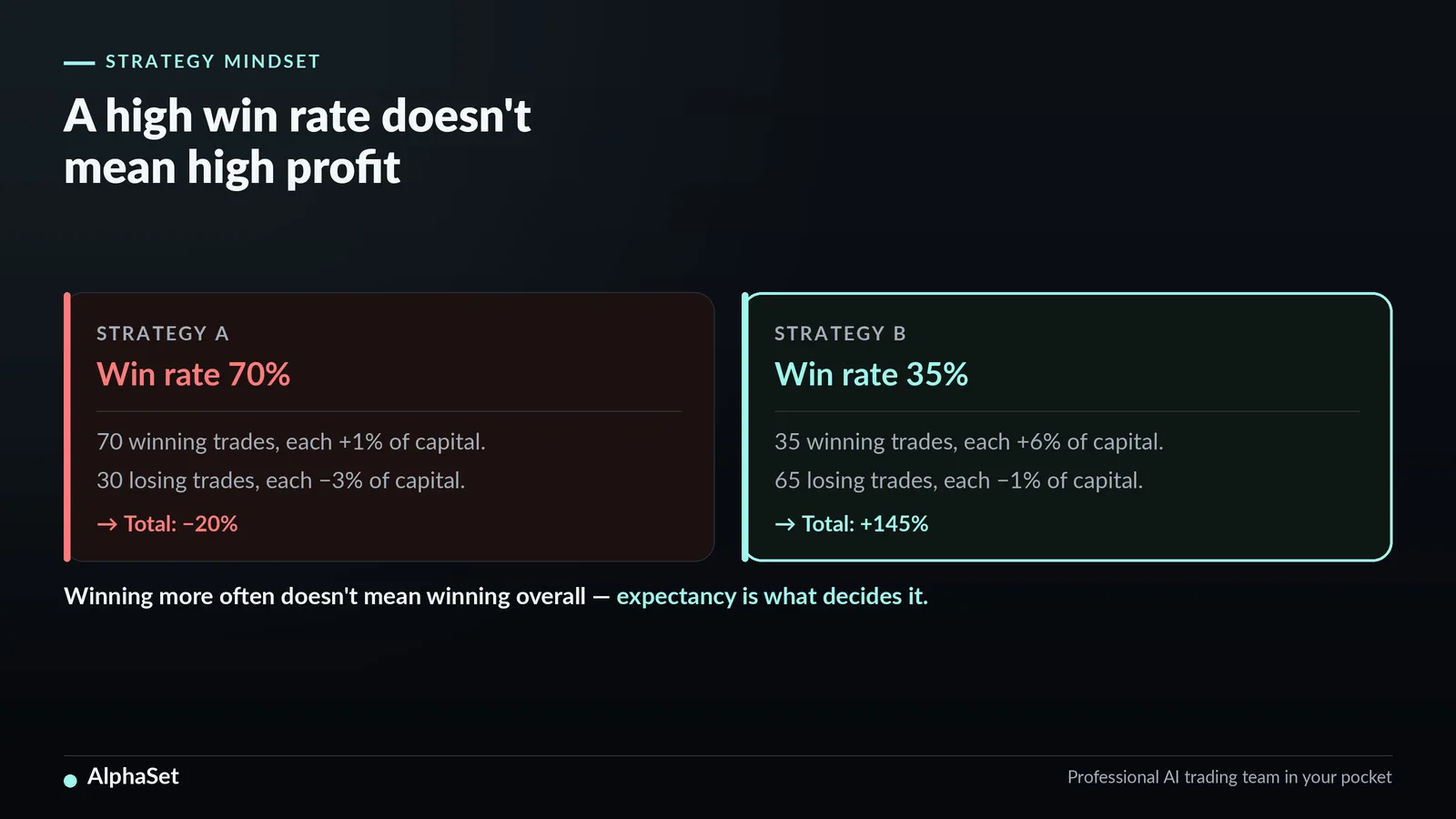
To see this paradox clearly, let's pit two real trading strategies against each other with the same assumption of equal position sizing and 100 executed trades:
Strategy A (High win rate - 70%)
This system gives you the feeling of continuous victory. Out of 100 trades, you win 70 trades, earning an average of 1% of capital per win; you lose 30 trades, losing an average of 3% of capital per loss.
Result: 70 winning trades = +70%, 30 losing trades = -90% => total = -20%.
You win consistently but end up with a net loss.
Strategy B (Low win rate - 35%)
This system forces you to experience more losses than wins. Out of 100 trades, you only win 35 trades, but by applying a good Profit/Loss (Risk/Reward) ratio, you capture 6% of capital per win. When you lose, you cut losses quickly and only lose exactly 1% of capital per trade on the remaining 65 losing trades.
After 100 trades: 35 winning trades = +210%, 65 losing trades = -65%. Total result = +145%.
The win rate is less than half that of Strategy A, yet the account grows many times over. This is the reality playing out every day in the crypto market.
What is Expectancy?
Expectancy (Expected Value) is the average amount of money or percentage that a trading system is expected to make (or lose) per trade in the long term, after accounting for the balance between both win rate and Risk/Reward ratio.
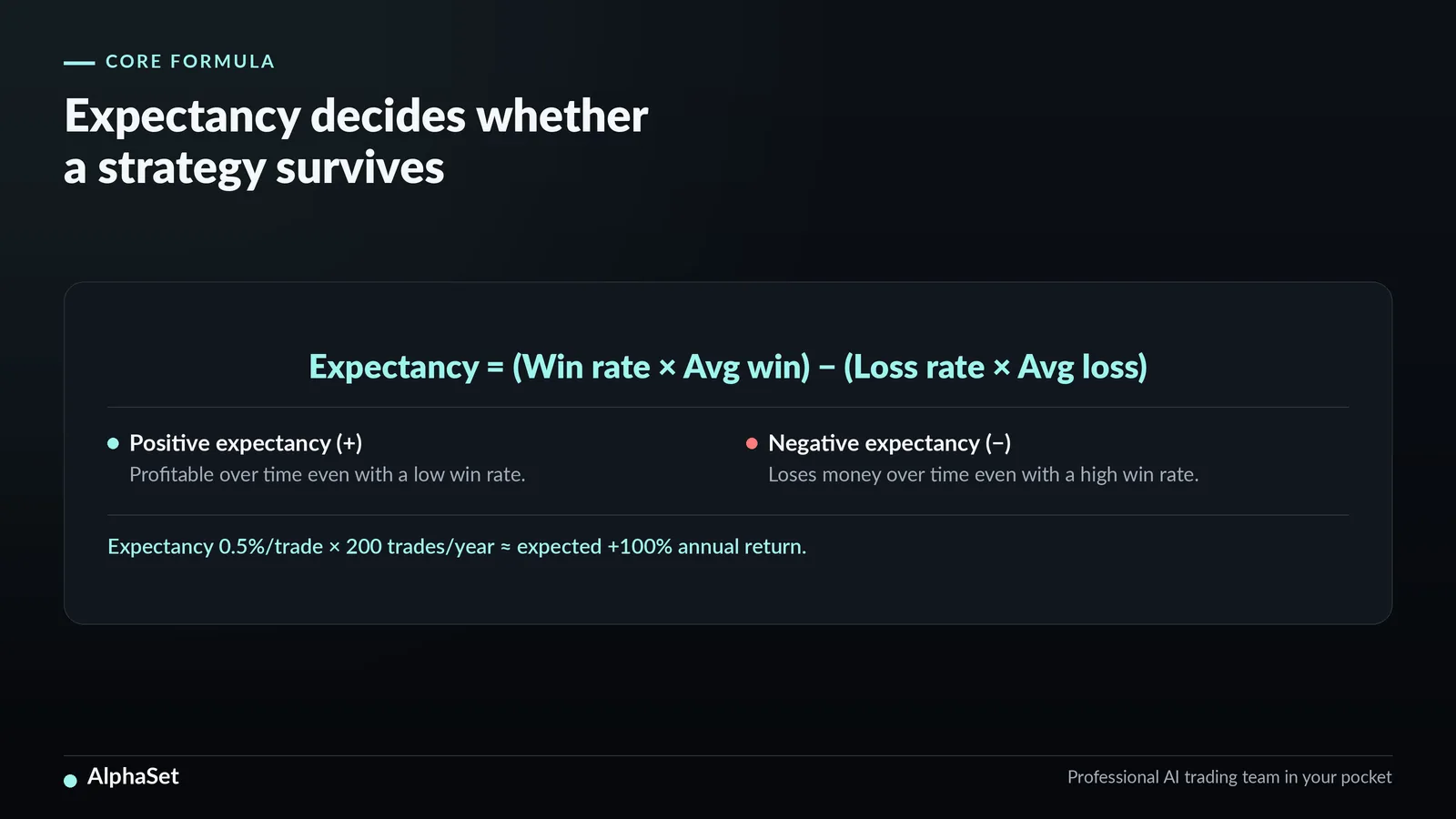
Expectancy = (Win rate × Average profit per win) - (Loss rate × Average loss per trade)
-
A system with Positive (+) Expectancy will certainly generate profits over time, no matter how low its win rate is.
-
A system with Negative (-) Expectancy will lose money over time, regardless of how high your win rate may be.
If a strategy has an Expectancy of 0.5%, it means that on average at scale, each trade you execute is expected to pocket 0.5% of your capital. After running approximately 200 trades in a year, the mathematically expected result will be 100% profit. Of course, actual results will fluctuate due to market randomness, but statistically speaking, a system with a stable positive expectancy index will always generate profits in the long run.
The Trade-off Between Win Rate and Risk/Reward Ratio
Understanding the mathematical formula above is only half the battle. The second half — where most traders get buried — is the psychological trap when executing the strategy.
Strategies that deliver extremely high Profit/Loss (R:R) ratios typically come with a harsh reality: low win rates. This means you must prepare yourself mentally to face extended streaks of consecutive losing trades. With a system that has a 35% win rate, experiencing 7 to 8 consecutive losses is completely normal and statistically sound.
Yet in practice, by the time you hit the 5th consecutive loss, most flesh-and-blood traders begin to panic, doubt their method, enter a state of anxiety, and then abandon or alter the strategy — exactly when the system is about to enter a winning streak that would have compensated for everything.
Conversely, high win-rate strategies provide immediate comfort and gratification to your ego, but one moment of weakness and emotional capital commitment, and a single black swan loss wipes out the gains from dozens of previous wins.
Executing a system based on Expected Value requires extremely high discipline.
To successfully operate a system based on Expected Value, you must strictly adhere to your entry and exit plan unconditionally, no matter how poor your recent results have been: After 5 consecutive losses, don't change position size. After 5 consecutive wins, don't increase size out of overconfidence.
Each trade needs to be viewed as a completely independent event, separate from the win/loss history that just occurred. This sounds very simple, but it's something 99% of individual investors cannot do consistently, because humans are creatures heavily dominated by short-term emotions.
Alpha Crypto: Optimizing Expected Value, Breaking Down Emotional Barriers
What is Alpha Crypto?
Alpha Crypto is an automated long/short trading strategy on the top 100 largest coins in the market from AlphaSet, a quantitative investment platform for individual investors. Unlike simply buying and holding, Alpha Crypto scores 100 coins, goes long on the strongest ones and shorts the weakest ones, helping you profit in both bull and bear markets instead of just waiting for price appreciation. The long/short ratio adjusts automatically based on market conditions, driven entirely by data and unaffected by emotions. Everything runs automatically 24/7 via API on your exchange account, with your capital remaining safely on the exchange and AlphaSet only having the authority to place orders, with no withdrawal rights.
Alpha Crypto optimizes Expected Value on each position
Alpha Crypto is built around Expected Value. Each trade is evaluated by the probability of success multiplied by the expected outcome, minus the probability of failure multiplied by the expected risk. A trade is only executed when Expected Value is sufficiently positive.
What the engine does that humans struggle to maintain is never changing behavior based on the most recent streak of results. No increasing position size after a winning streak out of overconfidence. No reducing size after a losing streak out of fear. No abandoning the strategy because of 5 consecutive losses when statistics remain within normal ranges. Each trade is executed following the same consistent logic, regardless of what happened before.
In investing, emotions destroy Expected Value in both directions: increasing risk when euphoric and cutting positions timidly when fearful — both behaviors will squeeze and distort long-term results, no matter how good your original strategy is. Alpha Crypto completely removes the human variable from that equation.
All your capital and assets are always secured and remain 100% safe on your personal exchange account. AlphaSet connects securely via API only to execute automated orders. You simply pay a fixed monthly service fee; the system commits to no profit-sharing fees from your account, helping you preserve the full fruits of your investment.
Ready to get started with AlphaSet?
Activate an Alpha today and let our quants automate your trading.
Get Started