

BTC and S&P 500: When Crypto No Longer Follows Its Own Logic
Many people turn to crypto with a strong expectation of "diversification": they believe that if traditional stock markets crash, crypto might rise, or at least stay flat to protect their total assets. This argument was once very valid and remains the core reason investors hold both stocks and crypto in their portfolios.

Yet in reality, especially during periods of global economic stress, Bitcoin (BTC) and the U.S. stock index (S&P 500) move in lockstep, "rising and falling together." Precisely when you need a life raft most, the benefit of diversification vanishes entirely. Understanding why and when this phenomenon occurs is the golden key to allocating your capital wisely.
What is Correlation?
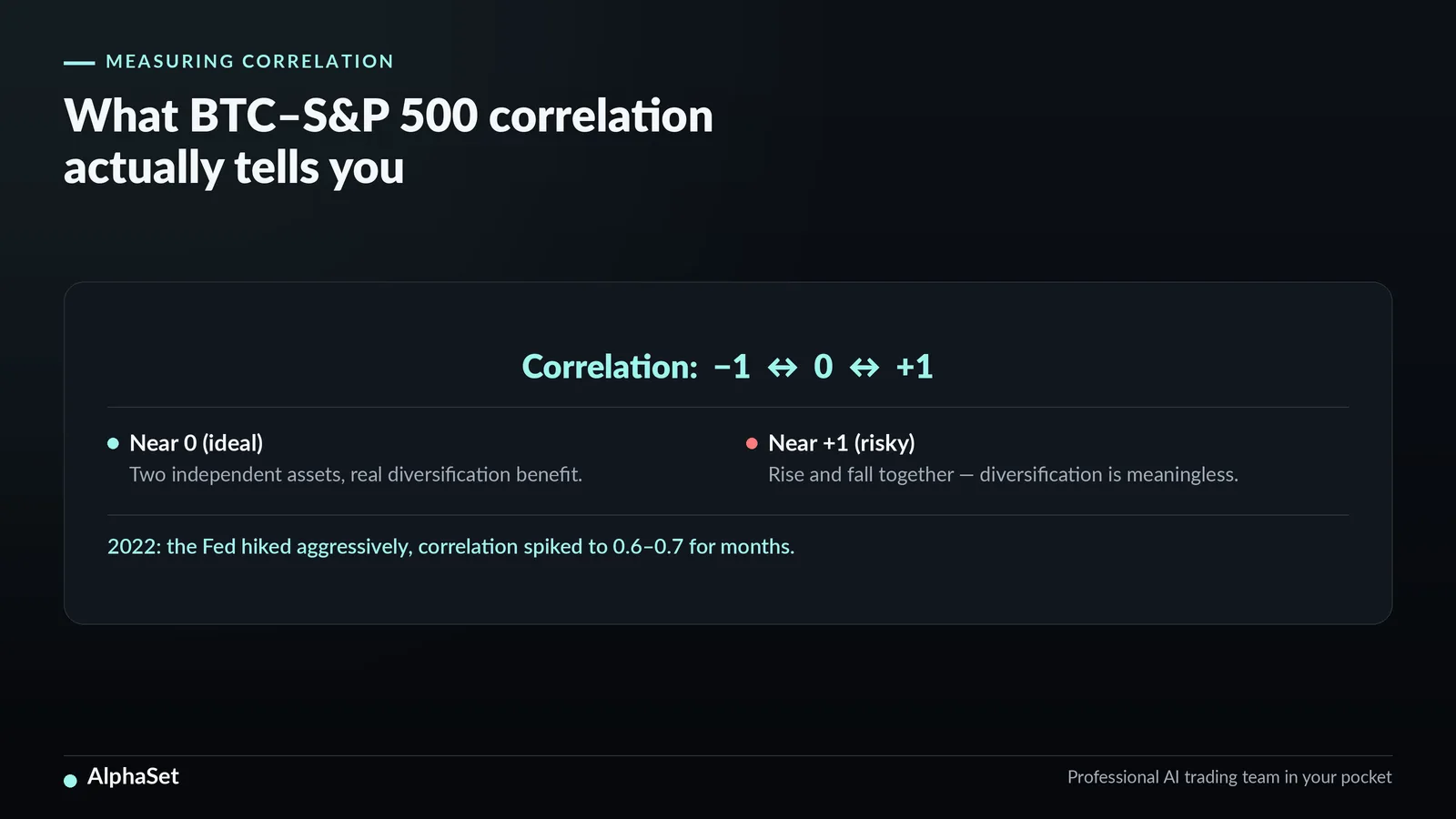
Correlation is a metric that measures whether two assets move in the same direction or opposite directions. This index is calculated on a scale from -1 to +1.
-
Equal to +1: Two assets always move in the same direction: both rise together, both fall together at identical rates. If you own both, portfolio diversification becomes completely pointless.
-
Equal to -1: Two assets always move in opposite directions. This is the perfect hedge to preserve your cash flow.
-
Equal to 0: Two assets are completely independent and unrelated. This is the ideal state for diversifying your portfolio. In crypto, to achieve this benefit, correlation with equities should stay low (below 0.3).
How Has the Relationship Between Bitcoin and U.S. Equities Changed Over Time?
Before 2020, BTC's correlation with the S&P 500 was very low, typically under 0.2 for long stretches. The two markets operated independently because crypto was primarily a playground for retail investors and a handful of specialized crypto institutions, with no presence from major traditional finance players.
From 2020 onward, when Wall Street mega-funds began accumulating Bitcoin and products like Bitcoin ETFs launched, this relationship flipped completely. In March 2020, Bitcoin and the S&P 500 plummeted together during the global selloff triggered by the pandemic.
By 2022, when the U.S. Federal Reserve (Fed) aggressively raised interest rates, both equities and crypto fell sharply, with correlation spiking to 0.6–0.7 for many consecutive months. That's when investors bitterly realized: both the stocks and crypto in their portfolios were evaporating at the same time.
Why Did the Arrival of Large Funds Increase Correlation?
The mechanism is actually quite simple and practical: When a mega-fund managing a diversified portfolio of assets (stocks, gold, oil, crypto) faces tight constraints—such as a margin call from stocks declining, or being forced to reduce risk per regulations—it will instantly hit the sell button on everything liquid, including Bitcoin. This action inadvertently forces Bitcoin to fall alongside equities, right when you need them to be independent.
Additionally, when bank interest rates rise sharply, capital tends to flow out of risky assets back into safe savings. Both technology stocks and crypto fall into the "high-risk asset" bucket, so they naturally get abandoned by capital flows following the same logic.
What Does Correlation Say About Trading Opportunities?
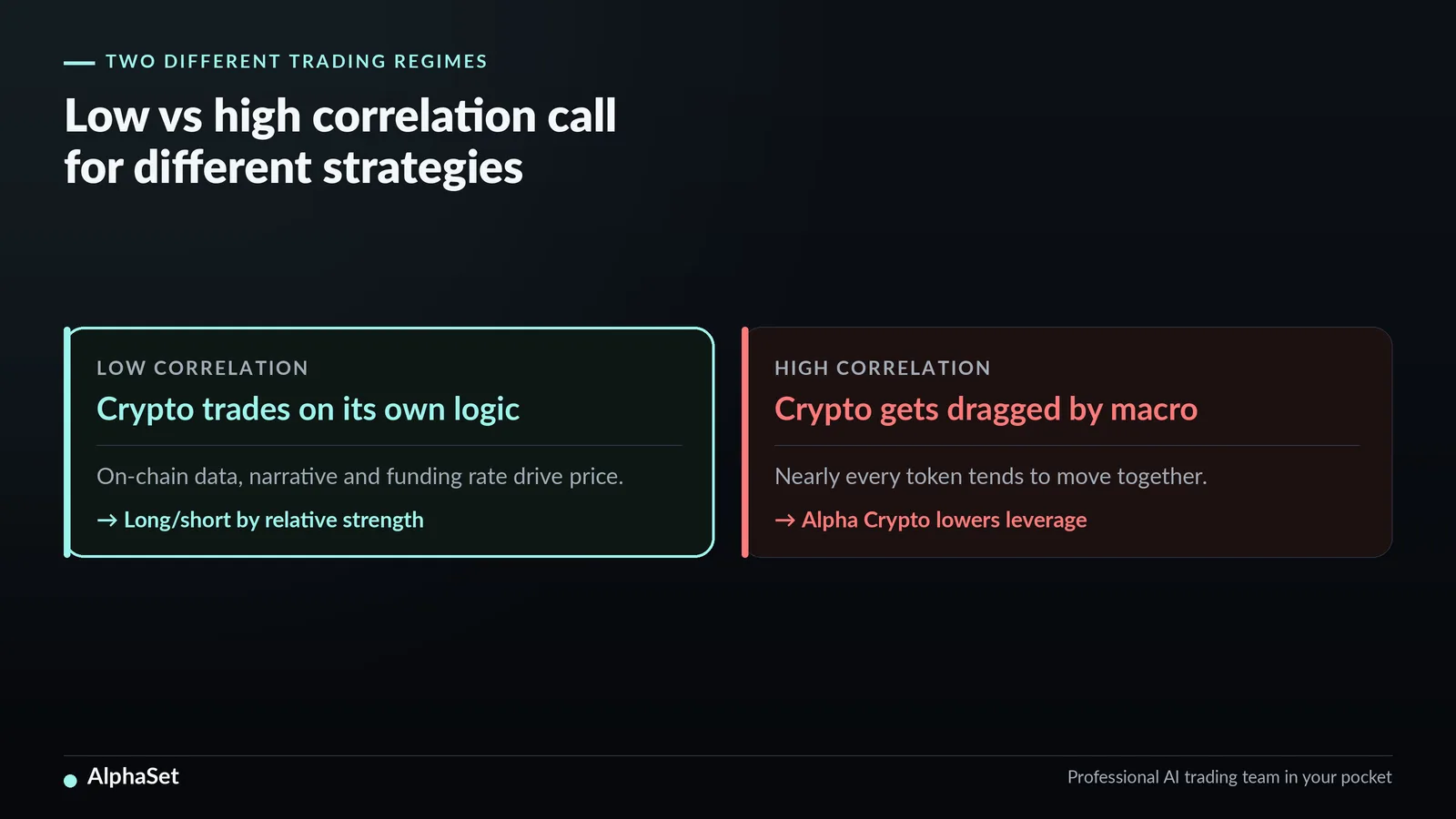
When BTC and S&P 500 correlation is low, crypto is moving by its own internal logic (on-chain data, narrative trends, funding rates, capital rotation between ecosystems). This is the environment where long/short strategies based on relative strength between tokens work most effectively, because the market is driven by crypto-specific factors.
When correlation is high, the crypto market is being dragged by global macro forces. In that phase, all tokens tend to rise or fall together; therefore, strategies based on divergence between tokens become less effective.
Alpha Crypto: Automatically Adjusting to the Global Economic Heartbeat
What is Alpha Crypto?
Alpha Crypto is an automated long/short trading strategy on the top 100 largest coins on the market, developed by AlphaSet, a quantitative investment platform for retail investors. Unlike simple buy-and-hold, Alpha Crypto scores 100 coins, buys the strongest and short-sells the weakest, helping you profit in both bull and bear markets instead of just waiting for price increases. The long/short ratio adjusts automatically based on market conditions, purely on data and free from emotion. Everything runs automatically 24/7 via API on your exchange account, with your capital remaining safely on the exchange—AlphaSet only has execution rights, never withdrawal rights.
Alpha Crypto Monitors Correlation as a Risk Adjustment Factor
Alpha Crypto incorporates the correlation index between BTC and S&P 500 as a critical macro filter. When it detects dangerously high correlation combined with heavy selling pressure from the U.S. stock market, the engine lowers overall leverage to a safe level. The system understands that risk is elevated, and individual analysis of each token is no longer optimal.
The engine's key advantage is its ability to act before consequences show clearly on the chart. A manual trader typically only accepts risk reduction and cuts positions after tasting losses from several consecutive losing trades. Emotion creates a fatal lag: You watch the U.S. market crashing but stubbornly maintain your crypto position, fooling yourself that "crypto is a different market, it's fine." By the time the selling wave cascades through your account, it's too late. The engine reads correlation as a pure number and adjusts instantly, preventing losses before they occur.
All your capital and assets remain secure and safely on your personal exchange account. AlphaSet connects securely via API only to execute orders. You pay only a fixed monthly service fee; the system commits to collecting no profit-sharing fees from your account, letting you keep every penny of your investment gains.
Frequently Asked Questions
What is correlation?
It's the degree to which two assets move similarly. Near +1 means they move together, near -1 means opposite, near 0 means unrelated.
Can crypto still diversify my portfolio?
It depends on the phase. When correlation with equities is low, yes; when global markets are stressed, correlation rises and diversification benefits shrink sharply.
Why does crypto fall at the same time as stocks?
When large institutions need to reduce risk, they sell across every market simultaneously; and high interest rates create pressure on all risky assets by the same logic.
How does Alpha Crypto use this correlation?
When correlation is high and macro conditions are poor, the engine proactively reduces leverage to lower systemic risk, rather than waiting until losses mount.
Ready to get started with AlphaSet?
Activate an Alpha today and let our quants automate your trading.
Get Started