

Why does news-based trading often end in painful losses?
One of the most natural reactions for new investors is to buy when there's good news and sell when there's bad news. On the surface, this logic seems perfectly sound—good news attracts buyers and drives prices up, while bad news triggers fear and drives prices down.

In reality, those who trade purely on this logic consistently experience bitter losses: the moment you buy on good news, you catch the peak, and the moment you sell on bad news, you cut losses right at the bottom. This isn't due to bad luck or slow reflexes—it's because the market operates under a hidden mechanism that makes this outcome almost inevitable, like a law of nature.
What is "buy the rumor, sell the news"?
Today's crypto market is a playground for thousands of large institutions, quantitative investment funds, and computer systems monitoring every fluctuation 24/7. When good news is about to break, it's usually already leaked or leaves data footprints beforehand. Those who know early, or ultra-fast algorithms, have quietly accumulated positions days or weeks before the announcement.
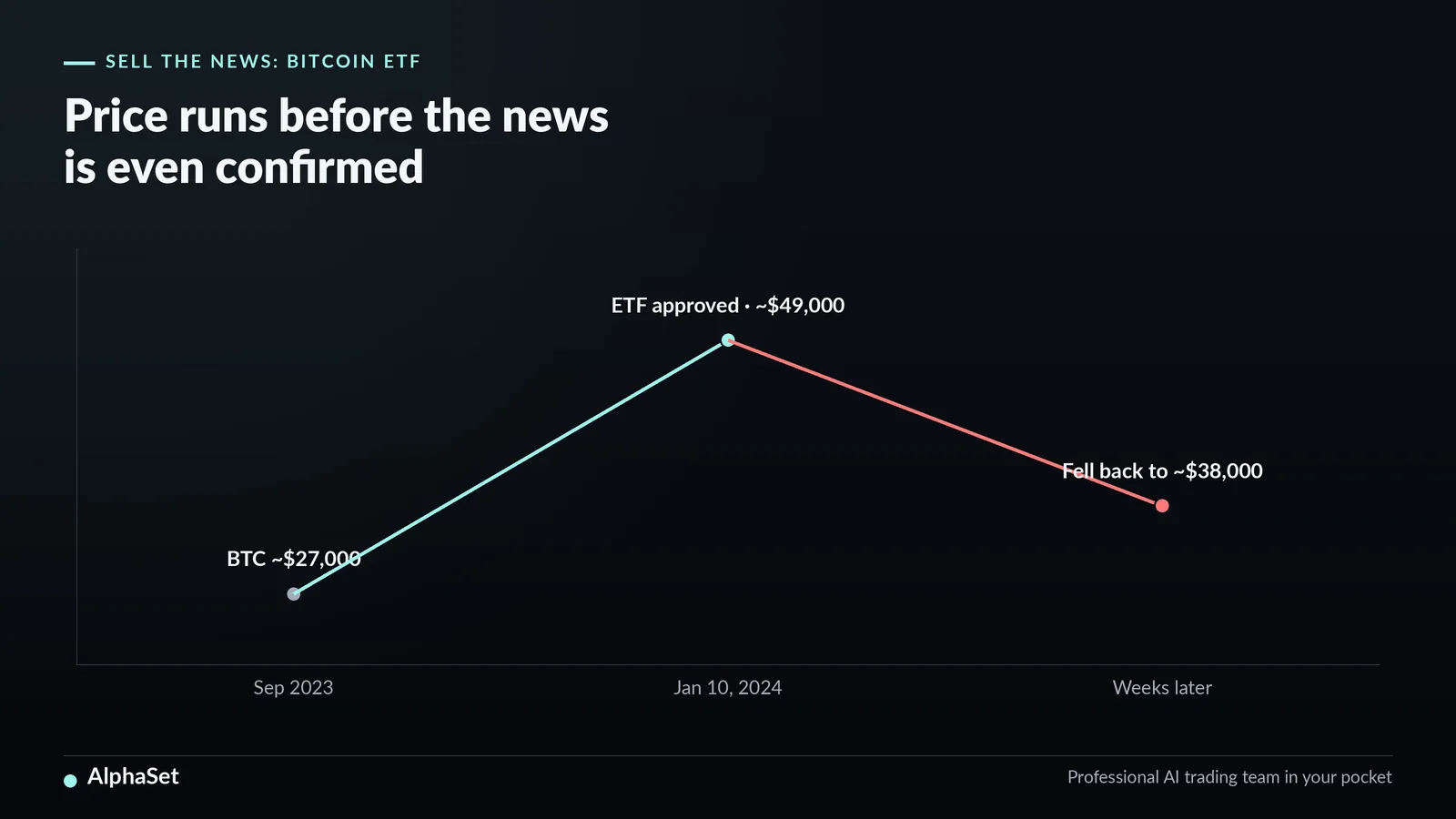
By the time official news makes it to headlines and spreads across Facebook, Telegram, or X (Twitter) for you to read, the coin price has already risen significantly. Traders buying after the news breaks are unknowingly becoming "liquidity"—they're essentially buying coins from seasoned players who accumulated early and now want to take profits. Fresh buying demand meets selling pressure from early holders, causing the price to stall or reverse sharply downward. This phenomenon is called "Sell the news"—when all positive expectations have already been priced in before the official announcement hits.
Textbook example: Bitcoin ETF approval in January 2024
The U.S. Securities and Exchange Commission's (SEC) official approval of Bitcoin Spot ETF was widely considered one of the biggest positive catalysts in crypto's history. Yet price action immediately after the announcement (1/10/2024) provided a costly lesson in "Sell the news."
Beforehand, buoyed by expectations of this event, Bitcoin price had quietly climbed from around $27,000 (September 2023) all the way to $49,000 on the very day the approval was confirmed. The market's entire euphoria had been "squeezed out" and priced in during the lead-up period. The moment official news broke, Bitcoin immediately reversed and plummeted to the $38,000 zone within just weeks. Those who frantically chased Bitcoin on ETF approval day suffered severe short-term losses, even though the news was obviously bullish in the long run.
When bad news strikes suddenly, panic selling is usually a mistake
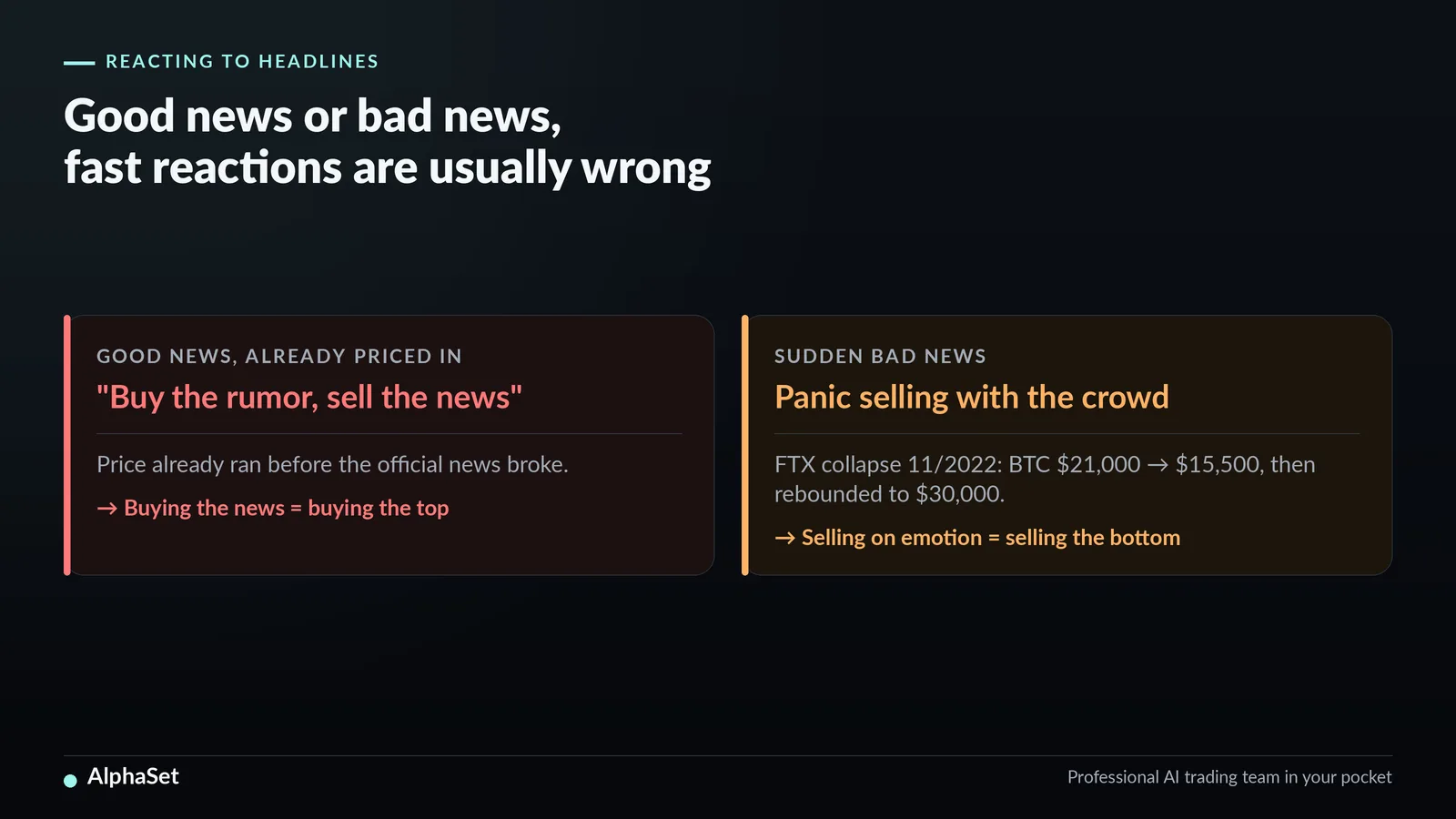
For unexpected bad news like major exchange collapse, project hacks, or sudden legal judgments—the story is different. Since it's unforeseeable, price crashes immediately before it's "priced in."
However, when you panic and hit the sell button with the crowd during those chaotic moments, you'll likely end up "selling the bottom." The crowd's frenzied selling pushes prices into oversold territory, creating a temporary floor before the market regains composure and recovers.
Example: November 2022, when FTX collapsed, Bitcoin panicked from the $21,000 zone down to $15,500 in just days. Those who couldn't take it anymore and sold in the $15,000–$16,000 range locked in losses right at the lowest point of that entire winter. Bitcoin then recovered strongly above $30,000 within months.
Why individual investors are always at a disadvantage when trading on news?
Speed is the critical factor. By the moment you see a message in a Telegram group, algorithms have already scanned that information minutes or even hours earlier. In fact, much news is already reflected in price through subtle on-chain money flows—data-driven movements days before the headline even exists.
A small retail trader without specialized tools or computer processing speed is essentially trading on information that's already "past expiration" with no profit potential left.
Trading on actual data with Alpha Crypto
What is Alpha Crypto?
Alpha Crypto is AlphaSet's automated long/short trading strategy on the top 100 largest crypto assets, built for individual investors. Unlike simple buy-and-hold, Alpha Crypto scores all 100 coins, buying the strongest and shorting the weakest, so you profit in both bull and bear markets instead of just waiting for prices to rise. The long/short ratio auto-adjusts based on market conditions, driven entirely by data and immune to emotion. It runs fully automated 24/7 via API on your exchange account—your capital remains on the exchange, and AlphaSet only has order-execution rights, never withdrawal rights.
Alpha Crypto reads data signals, not headlines
It's programmed to be completely immune to sensationalist headlines and media manipulation. Instead, the engine focuses on tracking the real impact of capital flows—something that never lies.
When rumors leak, whale wallets move first. Alpha Crypto catches this shift through on-chain money flow reversals, unusual volume spikes, or Funding Rate adjustments when large positions open. By analyzing these core data metrics, the system can detect momentum trends long before they become polished news articles distributed to the public.
When a normal person sees shocking news, they often panic or feel excessive euphoria: "This is huge, I must enter immediately or miss the opportunity!" That moment of greatest urgency is when you're most likely to make the worst decision—because that's when the news has already lost its value. The engine has no emotions; it reads all data objectively, protecting your account from the market's most sophisticated traps.
The system connects safely via API to execute orders directly on your personal exchange account. All your capital and assets remain 100% secure in your hands. AlphaSet charges a fixed monthly subscription (far lower than the cost of a single "buy the news" trade mistake) and never takes profit-sharing fees from your account, so you keep every penny of your gains.
Frequently Asked Questions
What does "price-in" mean?
It means expectations about an event are already reflected in the price before the official announcement. By the time official news drops, the price has already moved, so buying on the headline typically means you're late.
So should I never care about news again?
No. News is still important for understanding context. Just don't use headlines as buy/sell signals—you're almost always the last one to know.
Should I sell immediately if shocking bad news breaks?
Panic selling typically creates a short-term bottom and causes you to exit right at the floor. Better to assess rationally than react emotionally.
How does Alpha Crypto respond to news?
The engine doesn't read headlines; it reads the footprints news leaves in data (on-chain metrics, volume, funding rates, sentiment)—where real impact shows up earlier.
Ready to get started with AlphaSet?
Activate an Alpha today and let our quants automate your trading.
Get Started